
Businesses across the world are entering a new phase of workplace transformation driven by artificial intelligence, talent shortages and changing employee expectations, according to the Mercer Global Talent Trends 2026 report.
The study, based on a survey of nearly 12,000 executives, HR leaders, investors and employees across 16 industries and geographies, warns that organisations must rethink how work is designed if they want to remain competitive in an era defined by rapid technological change and economic uncertainty.
The report argues that achieving “exponential performance”—higher productivity, agility and innovation—will require companies to integrate artificial intelligence with human capabilities rather than simply adopting new technologies.
According to the report, 63% of executives believe redesigning work to incorporate AI and automation will generate the highest return on investment in 2026. Yet organisations remain far from ready.
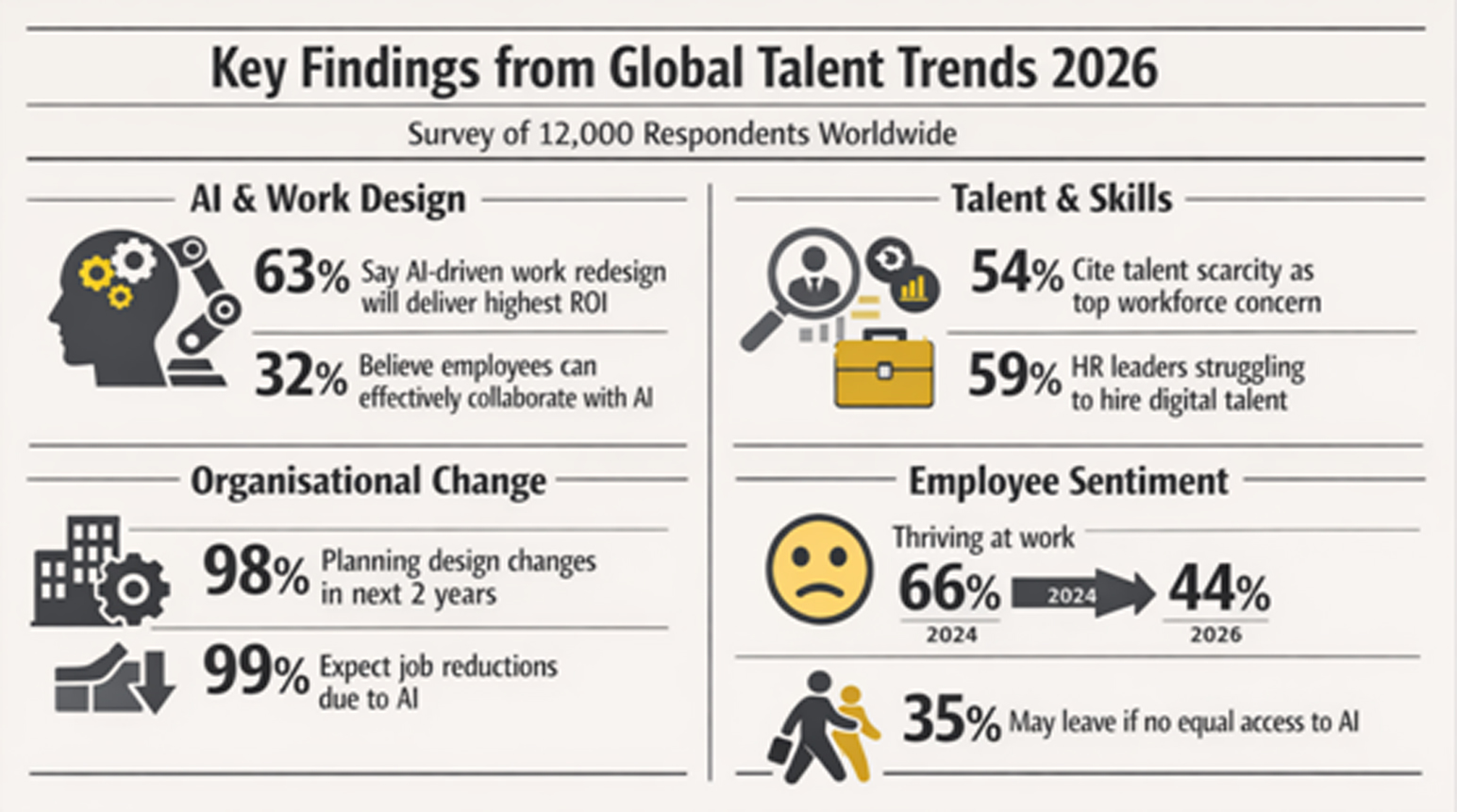
Only 32% of executives say their workforce can effectively combine human and machine capabilities, highlighting a major gap in skills, organisational design and leadership readiness.
Experts say companies must move from experimenting with AI tools to intentionally redesigning jobs, workflows and talent systems.
Another major concern is the global shortage of skilled workers, particularly those with digital and AI capabilities.
54% of the C-suite identified talent scarcity as the biggest macro force influencing workforce strategies, while 59% of HR leaders say attracting people with digital skills is their top challenge in 2026.
To cope with these pressures, many organisations are planning structural changes. The report notes that 98% of executives expect to redesign their organisations within the next two years, and 99% anticipate some level of job reduction due to AI adoption.
Also read – India’s Workforce Shifts Towards AI, Gig Jobs and New Skills: India Skills Report 2026
While companies race to adopt technology, employee morale is falling. The study finds that the share of employees who say they are “thriving” at work has dropped to 44% in 2026 from 66% in 2024.
Workforce anxiety is rising as employees worry about job displacement and unequal access to AI tools.
Around 35% of employees say they would consider leaving their organisation if they felt disadvantaged in access to AI training or technology, signalling the need for fair and transparent digital transformation.
The report also highlights the need for transformation within human resource functions. Only 8% of executives currently view HR as a strategically embedded function, suggesting HR departments must evolve beyond administrative roles.
Future HR teams are expected to play a central role in designing systems where human employees and digital agents work together, supported by stronger workforce analytics and skills-based talent strategies.