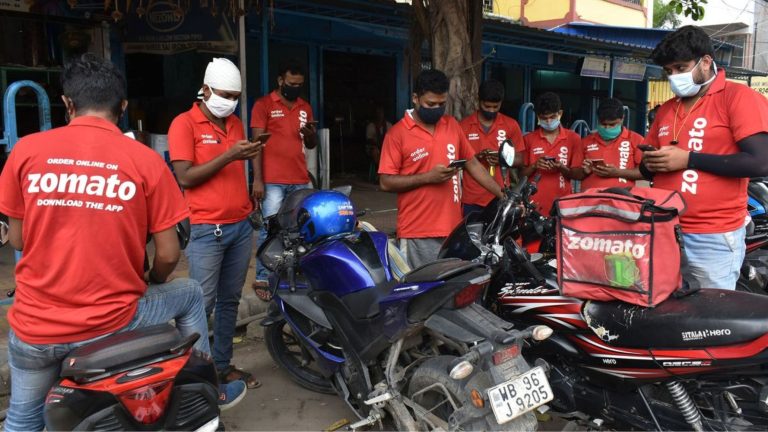
New Delhi, Dec 18, 2025: India’s rapidly expanding food delivery platform sector employed 1.37 million workers and generated a gross value of output (GVO) worth Rs. 1.2 lakh crore during the financial year 2023-24, according to a new report by the National Council of Applied Economic Research (NCAER), released on Thursday.
The study, Impact of Food Delivery Platform on the Indian Economy: GDP, Employment and Taxes, examines the economic footprint of digital food-ordering platforms and finds that the sector has almost doubled its output in just two years. Direct employment in the industry rose from approximately 1.08 million workers in FY22 to 1.37 million in FY24, marking a 28% increase over the period.
Despite accounting for only 0.2% of total employment, the sector’s growth rate outpaced the broader economy, with employment growing at a compound annual growth rate (CAGR) of 12.3%, compared with the all-India CAGR of 7.9% over the same period.
Economic Linkages and Multiplier Effects
The report highlights the strong multiplier effects generated by the food delivery ecosystem. For every Rs. 10 lakh of output generated by food delivery platforms, the broader economy sees about Rs. 20.5 lakh in total output, illustrating deep linkages with allied sectors such as logistics, restaurants, technology, and payment services.
Also read – EPFO Urges Employers to Enrol Left-Out Employees, Announces Six-Month Special Window
Growth in gross value added (GVA) also mirrored the sector’s expansion, rising from Rs. 24,315 crore in FY22 to Rs. 47,588 crore in FY24. The sector’s output now represents 0.5% of India’s services GVO, up from 0.14% two years prior.
In addition, indirect economic benefits were noted. The sector’s tax multiplier suggests that for every Rs. 10 lakh of production, nearly Rs. 40,000 was generated in indirect taxes, almost double what was directly attributable to the platforms alone.
Impact Beyond Employment
Beyond job creation and output, the sector appears to be reshaping business operations, particularly for restaurants and small food enterprises. A complementary study cited expanded market access, higher compliance and improved operational capabilities among restaurants leveraging platform services, indicating a structural shift in how food services participate in the formal economy.
Experts say that this evidence provides a more comprehensive empirical picture of how food delivery platforms contribute to India’s digital economy, suggesting policymakers may need to consider supportive measures that enhance worker protections while sustaining innovation and growth.