During this millennium, the Sustainability issue has emerged as the top of the agenda and as a basic guiding principle for businesses in the global marketplace, transforming corporate strategies, managing stakeholder expectations, and complying with regulatory frameworks. Commercial contracts have evolved as a critical medium for communicating responsibility and corporate long-term value creation. These provisions assist businesses in aligning with their sustainability goals, reducing risks, and showcasing responsible corporate conduct.As companies increasingly integrate environmental, social, and governance (ESG) principles into their operations, the ESG clauses are emerging as specialised provisions in commercial agreements that bind parties to environmental, social and governance standards, turning voluntary corporate goals into enforceable legal obligations. Compliance with ESG is becoming an imperative of corporate disclosure and a core framework for evaluation of business performance. Thus, we see a close connection between Campus to Corporate when we deal with the vast subject of ESG Management.
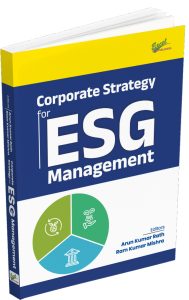
In this background, the recently published (March 2026) book jointly edited by Dr Arun Rath and Dr Ram Kumar Mishra,”Corporate Strategy for ESG Management”,is a path-breaking exercise, as it is not built up based onthe perspectives of a couple of the authors; rather the book, as a compendium, has successfully brought up diverse viewpoints from academia, researchers, practitioners, and policy makers with robust background and significant contributions to public life. This is more important as the core subject is growing every day based on our experiences and practice outcomes, globally. Both Dr Rath and Dr Mishra have huge illustrious careers behind them and thus they have put the best of their education, experience, exposure and contacts from their public life to build up this research-driven repository.
The contents of the book,covering 400+ pages,spread across 27 papers/articles in 4 tracks contributed by 42 distinguished authors, are mainly research-driven, supported with data.The track-wise distribution of articles is as follows,
Track 1: Overview
1. Corporate Strategy of ESG Management
2. Sustainable Project Management: Driving ESG in India
3. ESG Challenges: Performance and Expectations
4. Impact of ESG Disclosure on Firm Performance: New Evidence from Emerging Markets
5. Cracking the ESG Risk Rating Code: Towards Alignment among Rating Agencies
6. Reconceptualising ESG: A systematic Perspective on Environmental, Social, and Governance Independence in MSMEs.
7. ESG! What should I do?
Track 2: Environmental
1. From Fire to Hydrogen: Towards a Carbon-Neutral Civilisation
2. ESG in Oil and Gas Companies.
3. Challenges and Future of Indian Mining Companies in ESG Compliance
4. Climate Risk and How ESG Helps Mitigate it
5. Sustainable Financing: A Green Bond Perspective
6. Bridging the Readiness Gap: Financing Climate Projects in Emerging Asia
Track 3: Social
1. Ancient Knowledge and ESG Principles: A Comparative Analysis
2. Behaviour-Induced Costs in Circular Economy: Challenges and Opportunities
3. Grounding ESG: Tribal Communities, Local Governance and Forest Management in Jharkhand – A mirror for Corporate Practice
4. Corporate Strategy for ESG Management in the Context of India and Poland
5. Social Impact Management and Sustainability
6. Corporate Social Responsibility and Economic Development in India
7. Digital Pathways to Labour Rights: Assessing Wage Payments in India’s Rural Employment Guarantee Scheme
Track 4: Governance
1. Ethics and Values in Corporate Governance: A Strategic Imperative for ESG Driven Organizations
2. Integrating ESG in Public Policy: Sustainable Tourism and Hospitality in Asian Nations
3. ESG in India: Regulatory Approach and Imperatives for Businesses
4. Localising Sustainability: Integrating ESG Framework into 3rd Tier Governments for achieving SDGs
5. AI-Driven Governance: Transforming Modern Practices for the Future
6. Sustainability Signals and Bond Market Access: ESG in Emerging India
7. Revisiting Real Estate Regulation of India through the lens of ESG Compliance: A Review
The topics of the above scholarly articles/papers are themselves as a treasure for researchers as well as for practitioners from industry who want to have a pre-reading on the subject. Those who are interested in further insights can definitely reach out to the individual authors, as the editors of the book have mentioned the authors’ contact details, including e-mail. The book is going to be an immediate worthwhile collection for the HR community, as the industry is rapidly shifting to provide more and more strategic roles to the HR professional, and ESG management is emerging as a major role for them. As a process owner, they will be in a better shape with quality knowledge while transacting on the issue in corporate parlance. While such publications attract both academia and all verticals of today’s corporate but is worth mentioning that is of great help for HR to keep them future-ready while deliberating.
The book comes with good print and handy binding. We must be thankful to M/s. Excel India Publishers for their positivity and bringing this in. Personally, I look forward to the next edition based on the feedback of readers, and further advancement of studies and research inputs in the field. More so when we are slowly zeroing in on the UN target of SDG compliance by 2030. ESG benchmarking and compliance by corporations is definitely a great enabler in that direction.
By Indranil Banerjee, Kolkata
Authors : Dr. Arun Kumar Rath and Dr. Ram Kumar Mishra
Publisher : Excel India Publishers
Price : Rs. 1455/-
ISBN : 978-93-49666-43-6
Website : www.excelindiapublishers.com