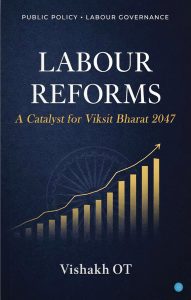
The book has 15 chapters comprising 75 topics. It started with foundational discussions on the evolution of Indian labour laws from pre-independence days, runs through the post-liberalisation regime and attempts to integrate the concept of Viksit Bharat. Consolidating 29 labour laws into 4 labour codes is a policy drafting achievement, but the real challenge is implementing it within the country’s federal structure, which comprises diverse viewpoints. The legal points of the codes are fixed and readily available in the pages. The beauty of the book is that instead of reproducing them, it delves into various dimensions of challenges. This book will be helpful for various stakeholders over time, not just for those exclusively handling related legal issues. In a mature democracy like India, implementation success will be limited unless we engage all stakeholders in critical dialogue. This book can be helpful as pre-reading for the stakeholders’ representatives before they engage in dialogue.
The first 8 chapters dealt with the foundation of labour reforms, the labour codes and governance aspects. It would be unfair to mention subsequent chapters and their broad contents while reviewing it. Those chapter overviews are like.
1. Stakeholder Perspectives: This covers the Industry and Employer viewpoint, Trade Union and Worker Concerns, Questions from MSMEs and Start-ups, the opinion of State Governments and Labour Administration as well as challenges the honourable Judiciary will face regarding Interpretation.
2. Political Economy and Resistance: This covers political narratives related to Labour Reforms, Myths and Misconceptions about the Codes, Protest Movements and Reality Checks, Media, Academia and Public discourse, Reform Fatigue and Change Management.
3. Comparative and Global perspective: This deals with labour reform in Emerging Economies, covering EU, ASEAN, and East Asian experiences, lessons for India.
Also read – Optiv appoints Nupur Bedi as Sr. Director – HR
4. Labour Reforms and Economic Outcomes: It delves into the impact on Employment Generation and Formalisation, Productivity and Competitiveness, Industrial Growth and Manufacturing Push, FDI, MSMEs.
5. Future of Work and Labour Policy: This elaborates on Automation, AI and job transformation, Skill Development and Labour Mobility, Platform Economy Regulation, and Remote Work and new Employment Structures.
The labour codes are in effect; state notifications related to the rules are forthcoming. The author speaks timely about strengthening implementation mechanisms, capacity building for labour administration, social dialogue and consensus building, and balancing flexibility and security. This approach aims to reduce conflict and enable lawmakers to take follow-up measures for further reforms during next 20 years. In conclusion, the author emphasises the labour reforms as a catalyst for growth, driving outcomes and leading the nation to Viksit Bharat. The book’s framework and content are quite handy for preparing initial remarks, composing a quality training program, negotiating labour issues, and most importantly for understanding the emerging social-scape of employee relations.
The audience will surely be attentive if one develops knowledge of the labour codes, integrating the perspective shared in the book with their own experience and exposure to the subject while delivering.
The 310-page book’s binding, paper quality, and font size are quite handy and might prove to be a better bedside table option than a smartphone for CEOs, HR, and other professionals over the next few months.
(Reviewed by indranil Banerjee)