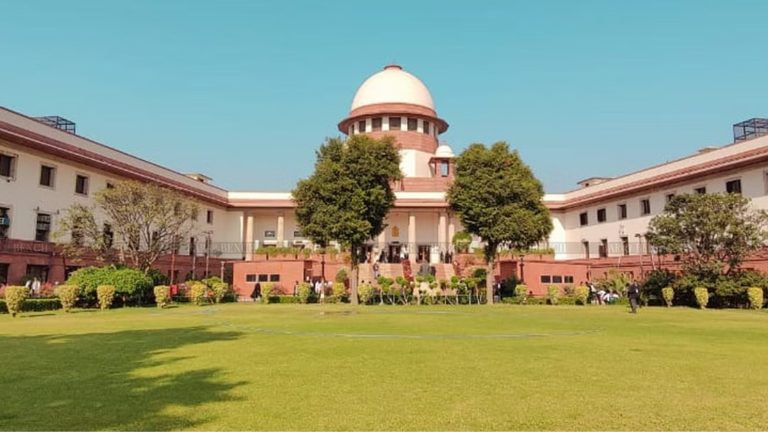
New Delhi, September 22, 2026: The Supreme Court has set aside a Bombay High Court order that had fastened liability on Oil and Natural Gas Corporation Limited (ONGC) to pay gratuity to workers engaged through contractors, holding that the Controlling Authority under the Payment of Gratuity Act cannot adjudicate upon and impose liability on a principal employer where the workers are not established to be its employees.
A Bench comprising Justice Ahsanuddin Amanullah and Justice Manmohan allowed a batch of appeals filed by ONGC and restored the orders of the Appellate Authority that had gone in favour of the public sector undertaking.
The judgment was delivered on September 9, 2026, in M/s Oil and Natural Gas Corporation Ltd. v. Suryakand D. Lad & Ors., along with connected matters. ( SLP (C) No. 498/2024 )
Dispute over gratuity of contract workers
The appeals arose from a common order passed by the Bombay High Court on August 23, 2023, in a batch of writ petitions. The High Court had upheld the liability of ONGC to pay gratuity to private respondents who had worked at ONGC establishments through contractors.
Also read – TAC Security Appoints Varun Khatri as EVP, People & Global HR
Before the Supreme Court, ONGC argued that the workers concerned were employees of the contractors and not of ONGC. Therefore, there was no employer-employee relationship between ONGC and the workers so as to make the corporation liable for gratuity under Section 4 of the Payment of Gratuity Act.
Solicitor General Tushar Mehta, appearing for ONGC, also argued that the Controlling Authority’s jurisdiction under the gratuity law was limited and that it could not determine the fundamental question of who was liable to pay gratuity.
ONGC further relied upon the contractual arrangement with the contractor, which expressly described the arrangement as a job contract and stated that it did not create an employer-employee relationship between ONGC and the contractor’s employees.
Controlling Authority exceeded its jurisdiction
The Supreme Court accepted the core jurisdictional objection raised by ONGC.
The Bench held that the proceedings before the Controlling Authority were not maintainable insofar as they sought to determine and fasten liability on ONGC. According to the Court, the statutory power of the Controlling Authority was to compute the amount of gratuity payable to the concerned “employee”, and not to adjudicate a disputed question of liability between a principal employer and workers engaged through a contractor.
“The adjudication by the Controlling Authority with regard to the liability was beyond its jurisdiction,” the Court observed.
The Court accordingly found that the Appellate Authority had rightly interfered with the original order and that the Bombay High Court was not justified in reversing the Appellate Authority’s decision.