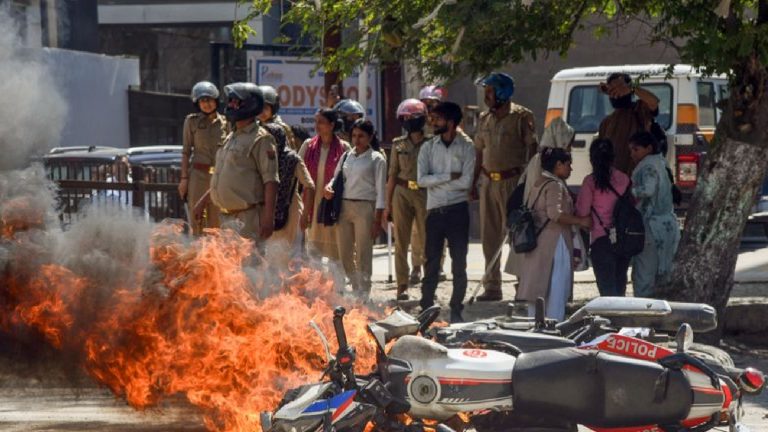
The industrial belts of NCR,stretching across Noida, Manesar, Faridabad, and Bhiwadi, have rarely witnessed such a synchronised wave of workers’ protests as seen in the last few days. What initially appeared to be a localised disturbance in the factories of Manesar soon revealed itself as something far deeper: a shared discontent cutting across state boundaries, sectors, and employment categories. The protests were not merely about wages; they were about dignity, parity, and the growing disconnect between workers and the management meant to take care of them.
It began in Manesar, the industrial heartland of Haryana, where workers raised their voices over wages and working conditions. The protests quickly escalated, spilling into acts of vandalism and confrontation. The state’s response was a substantial increase of 35% in minimum wages. It was swift and decisive on paper. Yet, instead of containing the unrest, it inadvertently set off a chain reaction. Workers in neighbouring regions, particularly in Noida, began to compare their own wages with those newly announced in Haryana. In an interconnected labour market, where information flows instantly through mobile phones and messaging groups, such disparities do not remain unnoticed for long.
Soon, Noida witnessed one of the most intense episodes of the unrest. Tens of thousands of workers mobilised, and what began as a protest over wages turned into a large-scale law-and-order situation. Vehicles were set ablaze, clashes broke out with the police, and hundreds were detained. The demands were straightforward—higher wages to match rising living costs equal to Haryana, but the scale and intensity of the protests pointed to accumulated frustration rather than a sudden grievance. Workers were seen venting out their grievances in social media videos. In a swift response, UP Govt also raised minimum wages to about 20% with 1.4.26, which are different for different regions. For Noida, the wages are highest now.
Also read – TCS suspends employees in Nashik case, reaffirms zero-tolerance policy on harassment
In Chopanki industrial belt of Bhiwadi, the unrest took on a slightly different tone but stemmed from the same roots. Workers not only demanded higher pay but also raised concerns about working conditions and supervisory behaviour. Here too, protests disrupted operations, and negotiations followed police intervention.
Meanwhile, in Faridabad, an industrial hub within Haryana itself, protests erupted despite the government’s wage hike. This paradox exposed a crucial gap: the difference between policy announcement and on-ground implementation. Workers alleged that management had neither communicated clearly nor implemented the revised wages on time. The result was a breakdown of trust.
Taken together, these incidents reflect a pattern that goes beyond isolated triggers. At the core lies a structural imbalance in the way wages are determined and perceived across states. When one state revises wages significantly while neighbouring states lag, it creates what may be called a “comparison shock.” Workers, especially in contiguous industrial clusters, do not see themselves as bound by administrative borders; they see themselves as part of a shared labour market. Any visible disparity, therefore, becomes a source of immediate dissatisfaction.
Overlaying this is the pressure of rising living costs. Inflation, particularly in essentials such as food, cooking gas, fuel, and housing, has steadily eroded real wages. For workers already operating at the margins, even a modest increase in expenses can create significant distress. In such a context, stagnant wages are not merely inadequate—they are perceived as unjust.
Another critical dimension is the widespread use of contract labour. Across these industrial belts, a significant proportion of the workforce is employed through contractors. This model, while offering flexibility to employers, often results in wage inconsistencies, limited benefits, and weak channels for grievance redressal and malpractices by contractors. Contract workers frequently feel excluded from formal communication systems and are less likely to have their concerns addressed proactively. This creates a fertile ground for discontent, which can escalate rapidly when triggered. Over all Contractors representatives’ rude behaviour, not paying their full wages rightly calculated, exploitation at their hands, adds fuel to the fire.
What is particularly striking in this episode is the speed of mobilisation. Digital communication platforms have transformed the dynamics of labour organisation. Messages, videos, and calls to action circulate instantly, enabling workers across locations to coordinate and amplify their protests. What might once have remained a localised issue can now become a regional movement within days.
Role of irresponsible posts in social media, which claimed during the last week of March that minimum wages are going to increase throughout India, effective 1.4.26. Such fake posts also declared wage rates. These posts had no govt. Orders back up,raising unrealistic expectations among the working class.
Against this backdrop, the responses from governments appear largely reactive. In Uttar Pradesh, authorities announced an interim wage hike following the protests in Noida, while also deploying a significant police force to restore order. Around 300 are reportedly arrested, including women in multiple FIRs. Haryana’s earlier wage revision, though substantial, lacked the accompanying mechanisms to ensure uniform implementation and communication. Across locations, the emphasis has been on immediate containment, through wage adjustments and law enforcement rather than on building long-term institutional frameworks for dialogue and dispute resolution.
Management responses, too, have been largely tactical. In many cases, communication with workers was delayed or insufficient. Wage revisions, where applicable, were not explained clearly, leading to confusion and suspicion. The reliance on contractors as intermediaries further diluted accountability, leaving workers unsure of whom to approach with their concerns. In some instances, allegations of harsh supervisory practices added a layer of emotional grievance to the economic demands.
For HR Professionals, this episode represents a significant failure of anticipation. The first gap lies in the absence of wage intelligence. In a highly competitive and interconnected labour market, it is no longer sufficient to comply with statutory minimum wages. HR heads must continuously track wage trends across regions and industries, anticipating the impact of changes in neighbouring states. The inability to foresee the ripple effect of Haryana’s wage hike on Noida’s workforce is a clear example of this blind spot.
Equally important is the lack of early warning systems. Indicators such as rising attrition, increased absenteeism, or informal complaints often precede large-scale unrest. In these cases, such signals either went unnoticed or were not acted upon. Communication, or the lack of it, further compounded the problem. Workers were left to rely on informal channels for information, which often led to misinformation and heightened anxiety.
The treatment of contract labour emerges as another critical area of concern. By keeping this segment at arm’s length, organisations have effectively excluded a large portion of their workforce from engagement and trust-building efforts. When unrest occurs, it is often this segment that mobilises most quickly, precisely because their grievances have remained unaddressed.
The role of frontline supervisors also cannot be overlooked. In several instances, worker dissatisfaction was linked not just to wages but to the way they were treated on the shop floor. This points to a gap in managerial training and accountability. HR systems that focus heavily on policies and processes but neglect behavioural aspects of management are ill-equipped to handle such situations.
This brings us to the central question: are the recent wage revisions by states like Haryana and Uttar Pradesh a solution, or merely a knee-jerk reaction? The evidence suggests that while such revisions are necessary, they have no rationale. Wage increases can provide immediate relief and may temporarily defuse tensions, but they do not address the underlying issues of trust, communication, and working conditions. The fact that protests continued even after wage hikes were announced underscores this limitation.
In many ways, these wage revisions function as pressure release valves. They alleviate immediate stress but do not strengthen the system. Without parallel efforts to improve transparency, ensure consistent implementation, and build robust channels for worker engagement, similar episodes are likely to recur.
What, then, is the way forward? For governments, there is a need to move towards greater harmonisation of wages across regions, particularly in contiguous industrial belts. More importantly, institutional mechanisms for tripartite dialogue bringing together state authorities, industry representatives, and worker groupsmust be strengthened. Five months have elapsed since making the Labour codes effective from 21.11.25, and there is no clue even about the national floor wage.
For HR, the lesson is perhaps the most profound. The role must evolve from administrative compliance to strategic industrial relations. This means building systems that are predictive rather than reactive, inclusive rather than segmented, and grounded in trust rather than control.
The recent unrest across Noida, Manesar, Faridabad, and Choplanki (Bhiwadi) is not an aberration; it is a signal. It points to the fragility of existing labour management frameworks in the face of economic pressures and social change. If there is a single takeaway, it is this: industrial peace can no longer be maintained through periodic wage adjustments alone. It requires a deeper, more sustained commitment to fairness, transparency, and engagement with the workforce.
Such events may eventually fade from headlines, but the questions they raise will remain. How organisations and policymakers choose to answer them will shape the future of industrial relations in India’s manufacturing heartland.