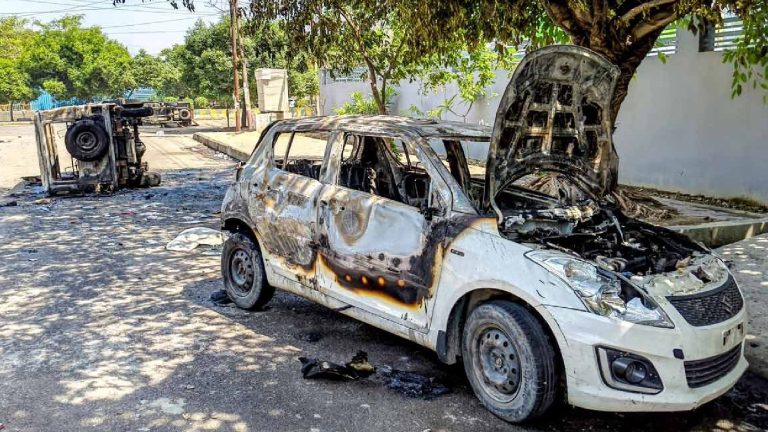
Noida, April 13: What began as a demand for wage parity with neighbouring Haryana escalated into widespread violence in Noida on Monday, as agitating industrial workers clashed with police, torched vehicles and vandalised property, bringing large parts of the city’s manufacturing hub to a standstill.
The unrest, centred in the Phase II industrial area and adjoining sectors, is being seen as a spillover of recent labour protests in Manesar, where a significant hike in minimum wages triggered similar demands across the border. Workers in Noida, many of whom are employed in garment and light manufacturing units, took to the streets seeking parity in wages, arguing that identical work across states should attract comparable pay.
As the protests swelled through the day, the situation deteriorated rapidly. Groups of workers blocked arterial roads, pelted stones and set at least one vehicle on fire, while several others were damaged. Eyewitnesses described scenes of chaos, with smoke billowing from burning vehicles and police attempting to disperse crowds amid mounting tension.
The agitation severely disrupted traffic movement across key routes connecting Noida with Delhi and Ghaziabad, with long snarls reported on major corridors. Office-goers and commuters were stranded for hours as authorities diverted traffic and struggled to regain control over the situation.
Officials said the protests had been building up over the past few days, fuelled not only by demands for wage parity but also by broader grievances, including delayed payments, lack of adequate bonuses and concerns over working conditions. Monday’s violence, they indicated, was the result of pent-up frustration among workers facing rising living costs without a corresponding increase in earnings.
The administration responded by deploying heavy police force in affected areas and initiating measures to contain the unrest. Senior officials appealed for calm and assured workers that their concerns would be addressed through dialogue. Emergency helplines were activated, and steps were announced to ensure timely payment of wages, enforcement of overtime provisions and improved workplace safeguards.
Industry representatives expressed concern over the disruption, warning of production losses and supply chain impacts if the situation persists. Many units remained shut through the day as a precautionary measure.
The developments highlight growing fault lines in the region’s industrial ecosystem, where wage disparities between states and mounting economic pressures are increasingly triggering worker mobilisation. The rapid spread of unrest from Manesar to Noida underscores how closely linked these industrial clusters have become, with localised issues quickly assuming wider proportions.
With tensions still simmering, authorities face the dual challenge of restoring order and addressing the underlying causes of discontent, even as stakeholders warn that failure to find a durable solution could lead to further flare-ups across the manufacturing belt.